
Training
This section gives broad guidance on training, covering each subject without going too deep. The information holds at any level and is aimed mainly at climbing on rock or at amateur training in the gym. At competition level every component of training has to be targeted, which would make it hard to separate the different approaches across the three disciplines — above all for Speed, a discipline practised almost exclusively by competitors and one that deserves a very specific approach that cannot be covered here. I am convinced that the movement of sport climbing belongs equally to Lead, to Boulder and to Speed, and for that reason I am working on a book that starts from biomechanics and goes on to analyse the physiology of movement, making the analysis of the three disciplines a single one.
WARM-UP
The warm-up is an integral part of a training session and has two main aims: the first is to prevent injury, the second is to prepare the body to perform certain actions as well as possible. In sport climbing injuries usually affect the upper limb, so it is important to mobilise the interphalangeal, radiocarpal, humeroradial and glenohumeral joints. The exercises can be done in many different ways; increasing their intensity stimulates the cardiovascular, musculoskeletal and neuroendocrine systems, and all of this raises the level of activation — that feeling which tells us our body is ready to give its best. I want to underline the word "feeling", because it is only the sensitivity we develop in listening to the signals coming from our body that helps us understand when a warm-up is complete: both the time and the stimuli needed to switch us on are absolutely personal. One very important thing to monitor is the capacity for recruitment. Have you ever wondered why, if you try maximal efforts at the start of a warm-up, the results are far below what you are capable of? Twenty minutes of warm-up obviously do not increase absolute strength; what increases is the ability to coordinate the musculature we have. In this sense some people reach a good level of recruitment with few stimuli, while others need more time. You can monitor yourself with specific exercises, such as one-arm hangs or moves on the pan, but it remains a partial check, because climbing is a set of far more complex movements. You have to learn to listen to yourself and, above all, to stop the warm-up once you have reached the optimal level of activation: insisting would only eat into your energy reserves. These considerations matter for a good training session, but they become essential if we want the warm-up to be followed by a good performance, whether on rock or in competition. Below I give guidance on the different kinds of warm-up to do depending on your goals and, above all, on the means available to you.
First, though, I want to point out two mistakes that recur in 90% of the warm-ups climbers do. The first happens when you want to redpoint a route: almost everyone feels the need for a short hard burn before the attempt. This comes from a poor warm-up, one in which you did not have the patience to get proper vasodilation first and proper activation afterwards. If you are trying an 8a you cannot warm up on 7b, unless you want to set off up the route with an acidic muscle pH and less glycogen in the tank. This holds for every discipline. The second happens when bouldering, on rock or on plastic: you do a couple of easy problems and by the third you already feel ready to pull on anything. Broadly speaking, warming up on easy boulders can be enough, but you have to give at least 20 minutes to that section of easy problems.
How to vary the warm-up according to your goal:
Training session in the gym:
- squats, 8 reps
- with 1-2 kg, hand rotations, 30 inward and 30 outward
- with 1-2 kg pronated, forearm curls, 14 reps
- with 1-2 kg, straight-arm lateral raises, 10 reps
- hanging on large holds, knees to chest, 10 reps
- hang on a sloper, 10 sec
- 1-4 pull-ups on the bar
- hang on a 2 cm edge, half-crimp, 10 sec
Repeat the whole thing 3 times, then add:
- 3 easy traverses of 15/20 moves with 3 min rest
- 6 easy boulders of 3/6 moves with 2 min rest
Redpointing a route:
- squats, 8 reps
- arm circles, 10 forward and 10 backward
- trunk rotations left/right, 20 reps
- full wrist and finger flexion-extension, 20 reps
Repeat the whole thing 3 times, then add:
- 3 routes at least one number below the grade you are trying (for 8a, 7a max) with 5/10 min rest
- try the individual moves of the route once; if there are more than 20 moves, do only the hardest ones
Sending a boulder:
- squats, 8 reps
- arm circles, 10 forward and 10 backward
- trunk rotations left/right, 20 reps
- full wrist and finger flexion-extension, 20 reps
Repeat the whole thing 3 times, then add:
- 5 boulders at least one number below the grade you are trying (for 8a, 7a max) with 3/5 min rest
- do 1 boulder one grade harder than the previous ones
These are broad indications and can be useful up to a medium-high level.
For anyone who genuinely climbs close to their limit, or who competes, the warm-up has to be individualised and set in the context of the situation and the discipline being faced.
GENERAL CONDITIONING
By general conditioning I mean training all those muscle groups that do not fall into the category of specific muscles, which in my own classification stops at the flexors and extensors of the fingers. This is certainly true in lead; in boulder it holds up to the point where coordination is not limited to pushing with the legs or to opposition done with an open hand. In speed, on the other hand, the specific muscles belong to the kinetic chain that extends the ankle, knee and hip, along with the whole flexor-extensor chain that governs how the arm is thrown. Even in Speed the quality of the grip remains important, as the precondition for being able to push with the lower limbs at all. Training the non-specific muscle groups has to be completely different, above all in terms of quality where lead is concerned.
With that necessary premise in place, here is some advice for getting real benefit out of general conditioning:
- concentrate this kind of training at the start of the plan and in deload periods
- work at 80% of your one-rep max, 5 reps x 5 sets per exercise
- do not work with maximal loads; better to do 2 reps if you need to get close to maximum effort, since whatever gain you might get would not justify the risk of injury, which is common in this kind of training
- limit as far as possible work that produces a significant amount of lactic acid: exercises that build up waste inside the muscle only make sense when training the specific movements
- favour exercises that require the coordination of several muscle groups over those that isolate single muscles
- prefer machines to free weights: machines make it easier to keep good posture under load
- for the lower limbs you can add sprints or hill work to vary the training stimulus
- at the end of the session do 20 minutes of stretching for the muscles that have worked
In boulder and in speed, training the large muscle groups has to be different and must include specific strength and speed exercises.
STRENGTH
Strength is the physical quality that, in climbing, governs the execution of increasingly complex movements; in most cases the limiting factor is the musculature of the forearm, above all in lead. The specific muscles are the deep and superficial finger flexors: although they always work in synergy, the first is essential on open-hand grips and the second on crimps, and for mechanical reasons the short and long extensors of the carpus should also be counted among the specific muscles. Together these muscles determine whether you can hold small or awkwardly shaped holds; in the end it is mainly these areas that keep you on the wall. The forearm musculature is far more complex, but for the other muscles it is coordination rather than intrinsic strength that affects the final result. Take the antagonists, which we can loosely call the extensors: it is their ability to modulate their contraction that determines the angle between metacarpus and radius and lets the flexors work in the most favourable condition. To build the finger flexors effectively you also need to do specific exercises with a bent arm, because these muscles work differently depending on the angle between forearm and upper arm. This observation is backed up by something anyone can verify: hanging on one arm, you hold the grip better when the arm is slightly bent. The explanation is not just mechanical — that bending the arm shortens the lever of the body and reduces the chance of swinging — because if that were all, staying perfectly vertical would be enough to produce the same force. Holds are held better with a bent arm because of the way the flexors of the hand and fingers originate. In particular the radial and ulnar carpal flexors, the palmaris longus, the superficial finger flexor and the pronator teres cross the joint and contribute in part to flexing the forearm on the arm; these muscles can develop more tension when the elbow angle is not fully open. That is why, in fingerboard and dry training, it is important to do the exercises through the whole range of angles.
Let us now look at how the strength of these muscles can be improved. The energy needed to develop high tensions is supplied by the anaerobic alactic system, the one that uses the ATP (adenosine triphosphate, the molecule that releases energy) stored in the muscles and CP (creatine phosphate, the molecule that carries energy). These molecules cannot be increased directly, but structurally it is possible to increase the contractile material of the fibres, especially the fast ones. That greater cross-section raises the possibility of expressing higher levels of strength, helped also by an indirect increase in the ATP and CP that can be stored. I say possibility, because if that increase in cross-section is not matched by effective recruitment, we will not be able to use our muscular capacity fully. The exercises that improve these qualities are those that lead to fatigue and to the consequent inability to continue within 3/8 seconds or repetitions. Other muscles can also be included in strength training: in boulder especially, the kinetic chains developed in compression and extension movements are fundamental. Compression happens when the holds cannot be pulled but have to be squeezed, as often occurs on wide moves between slopers; the specific muscles here are the pectoralis major, the front portion of the deltoid and the long head of the biceps. Extension movements occur in hand-foot matches and in almost every mantel, and their specific muscles are the triceps and the rear portion of the deltoid. It is important to note that training a single muscle is not as effective as doing exercises that involve the whole kinetic chain.
ADVICE
- each exercise should last between 3 and 8 sec
- the minimum number of stimuli per session is 6, the maximum 18
- rest between sets should range from 2 min (the time to recharge 80% of CP) to 5 min (activation starts to drop)
- let 36 hours pass before doing another strength session
- during loading periods do not let more than 4 days pass between one strength session and the next
- when you boulder on rock or plastic you are training this muscular quality too: take it into account in your plan
- for dry training use holds smaller than 1.2 cm only to develop sensitivity on narrow crimps. Do not do maximal strength exercises with that kind of grip; work on it at body weight instead
- in dry training do not use single-finger holds such as one- or two-finger pockets: they increase the load on individual tendons with no objective benefit compared with an exercise done with all the fingers
- do not do too much training with closed elbows; stop it for 2 weeks if you feel pain
- alternate static-isometric exercises (seeking maximum tension) with dynamic-isotonic ones (seeking maximum coordination)
- every 4 strength sessions, devote one to a 50% load at maximum speed (still between 4 and 10 sec)
- at the end of the session do 4 exercises at 70% load, looking for the feeling of a lighter effort. Strength exercises "train" you into massive recruitment that can happen even when it is not needed; reminding the nervous system that the fibres can work asynchronously to save energy also improves proprioception
ENDURANCE
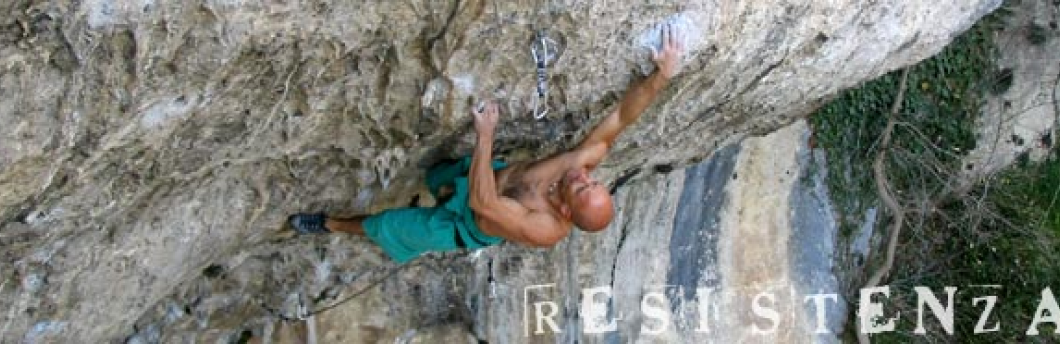
Endurance is the physical quality that allows effort to be sustained over time in relation to its intensity. In climbing it is essential to underline the word intensity, because in almost every route or boulder it varies continuously. While in competition the aim is to make the line as homogeneous as possible, on rock the changes of pace are frequent, above all on slabs. Considering that the duration of the performance can also vary a great deal both in competition and on rock, we can say that training endurance in climbing is a very complex matter. As with strength, the muscles that set the limit on sustaining effort over time are the flexors of the hand and fingers; the energy systems in play are the anaerobic lactic and the aerobic, but the ability to develop high levels of strength has a direct bearing on endurance, for physiological reasons that cannot be analysed here. The first of these systems rebuilds ATP molecules in the partial absence of oxygen, releasing lactate and H+ into the muscle; the second rebuilds ATP in the presence of oxygen, releasing water and carbon dioxide. Anaerobic glycolysis produces ATP faster than oxidative phosphorylation: 64 molecules instead of 36 per unit of time. On the other hand, while in oxidative processes the glucose molecule is completely broken down and yields 36 ATP molecules, in anaerobic glycolysis one glucose molecule yields only two. So the anaerobic system is more powerful but less efficient, consuming large quantities of glycogen and releasing the hydrogen ion, a proton that inhibits muscle contraction by lowering pH. Whether energy needs can be met by the aerobic systems depends essentially on the intensity of the movements and on the capacity to consume oxygen, and indirectly on strength levels as well. Maximum oxygen consumption is limited by two factors: cardiac output and capillarisation. The anaerobic lactic system is limited by muscle glycogen stores, by the tolerance of the tissues to an acidic environment, by the ability of the cell membrane to transport lactate and H+ out of the white fibres, and by the use of lactate by the adjacent red fibres. Let us bring all this back to climbing: when a climber falls, in most cases they feel pain in the forearm caused by a build-up of hydrogen ions, which would point to anaerobic glycolysis as the main limit. But that is only partly true. At a given intensity, I believe it is more important to work on absolute strength and on maximum oxygen consumption than on lactic power, for two reasons: 1) raising strength levels increases the initial ATP and CP stores, but also the ability to make the muscle fibres work asynchronously, allowing them to be partly recharged by the aerobic system; 2) raising the capacity to consume oxygen delays and then limits the demand placed on the anaerobic lactic system. This certainly does not hold for athletes competing in lead or aiming at onsight ascents on overhanging walls with no rests. In those cases the intensity sustained over long sections is so high that specific training is needed, above all to improve lactic power and therefore the efficiency of the transport proteins in the cell membrane. In boulder the situation is more complex still: the problems differ enormously in their energy demands, and endurance understood as lactic power can be a decisive quality in this discipline or go completely unused, depending on the problem. As for speed, at high level any kind of endurance is negligible and performance comes down to the ATP and CP already present in the cells. The specific exercises for endurance fall into two broad categories: those done in one go and those built from repetitions separated by rest. Of the two, the first are preferable, being generally more specific and closer to the kind of demand involved; the second type serves above all to train the tolerance of the tissues to an unfavourable pH. The duration can range from ten seconds to ten minutes.
ADVICE
- in most cases, at amateur level, training strength and climbing on rock can be enough to raise your endurance
- if you are not a high-level athlete do not do exhausting endurance exercises; the muscles get heavily poisoned, anyone who is not particularly well trained needs very long recovery times, and the chance of injury grows in proportion to the fatigue, which degrades coordination
- always place endurance exercises within a plan that includes deload periods
- anyone competing in boulder should include periods of training to raise the maximum oxygen consumption of the specific muscle groups; this quality improves the restoration of energy stores between one boulder and the next
- the body puts defence mechanisms in place when a muscle drops its pH, and getting used to the feeling of fatigue the muscles send you is one of the aims of endurance training. It is also a question of will: that is what lets you keep the same concentration in a fatigued state. A useful exercise for developing this kind of sensitivity is to add 10-15 small, close-together holds at the end of a demanding session; these last moves should be of medium-high intensity but low technical demand
- for an endurance exercise to be effective the setting has to strike the right compromise between intensity and duration; if you train with someone more experienced who knows your level, let them do the setting
- turn your attention also to finding rhythm and modulation. Every sequence of moves has its own rhythm, which has to be understood and internalised in order to progress with the least expenditure of energy. To that must be added modulating the force with which you squeeze the holds, which has to be calibrated to what is actually needed
COORDINATION
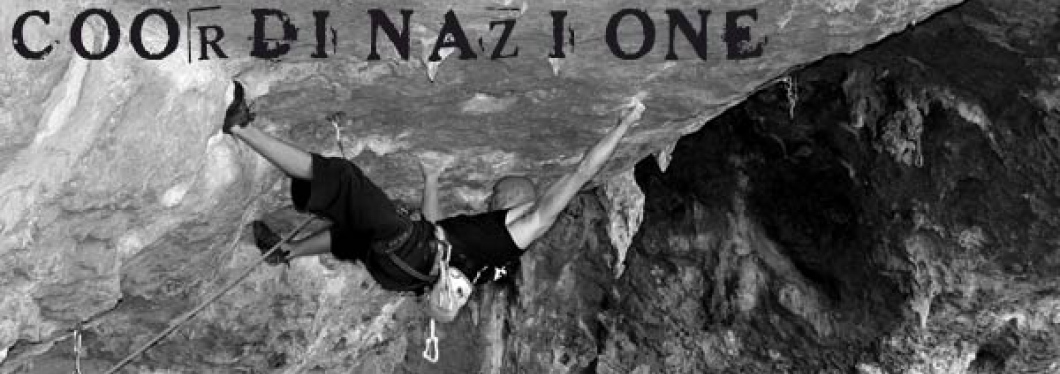
In sport, coordination is the quality that allows a position to be held or a movement to be performed with the least expenditure of energy, or with the greatest effectiveness, or at the greatest speed. There are two levels of coordination, intramuscular and intermuscular. In the first case it is essential that the muscle contracts by exactly as much as is needed to overcome a given resistance: excessive contraction can be limiting not only in energy terms but also for the economy of the movement as a whole. In the second case what matters is the timing with which the various contractions occur. At the first level the most frequent error is excessive contraction of the forearm musculature, for example while clipping when the protection is far away, and in every moment of uncertainty produced by a particularly complex move. At the second level the most obvious error is a failure of synergy between the different kinetic chains. Very often the movement of the legs and even of the trunk follows that of the arms passively, without taking any direct part in it: the typical example is the barn door, where the legs are not brought back in immediately but swing while the kinetic energy runs out. Worse still are broken movements, where the push of the legs does not happen at the same time but follows the action of the arms, greatly reducing the reach the combined movement could allow. In strictly theoretical terms, excellent coordination should make it possible to climb a whole route or boulder at a constant speed (leaving aside the start), which is clear from watching high-level speed athletes, where every foothold is immediately met by a push that keeps the whole execution from ever stopping. Every movement should make the most of the kinetic energy of the one before it, keeping moments of acceleration and deceleration to a minimum. That is certainly true in theory, but in practice rests, certain dynos and the need to express different levels of strength inevitably force changes of speed in lead and boulder. Beyond specific situations, it is always worth trying to carry speed through even when the body appears to be still. Let me explain: a position with the hands fixed and 4 or 5 successive foot movements might suggest there is little to save, whereas each placement of a foot can intrinsically contain part of the movement needed to place the next one. This is a complete view of climbing, one that does not stop at holding a given hold or placing a foot correctly, but that leads a person to explore their own potential.
This is the hardest quality to improve; it takes patience, humility and above all curiosity. It is a personal search: a good coach has to offer the right stimuli for understanding certain dynamics, but from there what matters is the athlete's own willingness to get involved.
ADVICE
- Film yourself; we often think we climb one way and in fact climb quite another
- Climb easy routes trying to keep a constant rhythm, and try the same on simple, rhythmic boulders
- Look for a feeling of continuity of movement when you work a route. It is very important to "work" the moves on the ground and to register every sensation; mentally you will notice that you arrive at the next hold without being fully aware of what happened a moment before. Stop and start again: picturing the movement is the first step towards good coordination
- When you fall on a boulder or a route, do not immediately put it down to a physical shortcoming; first you have to analyse how you executed it
TECHNIQUE
In climbing, talking about catalogued techniques is useful only for the purposes of communication. That does not mean technique is unimportant: training technique is such a complex matter that reducing it to an analysis of the so-called "fundamental techniques" risks becoming an end in itself. Cataloguing the various techniques (front-on, outside edge, same-side, and so on) certainly makes life easier for instructors, but training technique is another matter entirely. Correct technical execution depends exclusively on the ability to produce the right contractions, modulating the joint angles as functionally as possible. This learning process is acquired over years by internalising intra- and intermuscular coordination according to precise parameters of execution generated by the modulation of angles; the technique applied will be the consequence of that process. This is a complex subject that involves the physiology of movement itself and cannot be analysed here; I am writing a book that describes this research.
ADVICE (these are rough pointers; they cannot describe the ideas set out above)
- Climb on every kind of terrain (overhangs, slabs, corners, cracks, boulders, routes, traverses, rock, resin).
- When you climb with other people, try their solutions too.
- As well as taking part of your weight, footholds have to give the movement a direction.
- It is wrong to associate technique with slab climbing: climbing on overhangs calls for far more complex techniques and the development of completely new motor patterns, whereas slab climbing is close to the ordinary ways we relate to the world around us — we only use the overhanging position when we sleep
- As far as possible try to use an open or half-open grip, even if crimping gives you more confidence. Flexing the phalanges hard gives a feeling of greater stability, because more force can be developed when the angles are closed; on the other hand, the more you flex the phalanges the smaller the contact surface the holds offer and therefore the mechanical friction between hold and skin. Climbing half-open can feel insecure at first, but it is a technically more advanced grip that saves a great deal of energy.
- When you climb on overhangs, do not squash your body towards the wall.
TACTICS
Tactics are the set of decisions aimed at organising the execution of movement. It is always better to make as many decisions as possible while still on the ground, which does not change the fact that in competition and in every onsight situation some adjustments are inevitable. So the organisation of tactics has to be traced back to two different moments: the "before" and the "during".
This leads to the development of two abilities:
- The ability to read
- The ability to adapt
The ability to read is expressed above all on the ground: working out the right sequence before starting to climb saves a great deal of energy. Identifying the rests and the most intense sections also tells us the pace at which the route should be tackled: there is no point stopping to chalk up if there is a good rest a metre higher. To improve this ability you have to study the sequence carefully and then compare the decisions you made with the results you got; the learning process is based entirely on that comparison. The ability to adapt is expressed on the wall and allows you to adjust your earlier assessments to what the specific movement actually demands. That does not make the initial reading useless: remembering where a foothold is without having to look for it, for instance, lets you reorganise the movement very quickly. It is a very instinctive quality, strongly influenced by your psychological state: realising you have got it wrong very often leads to giving up before your energy reserves are actually spent.
What follows is advice for three different kinds of performance.
ADVICE
A worked route:
- go through the whole sequence on the ground; while you do, there should be no hesitation
- identify precisely the hard sections, the rests and the sections of medium intensity. The latter should be climbed without jerking, with the feeling of "floating" on the holds
- at the rests, focus your attention on the sensations coming from the finger flexors so as to understand when it is time to set off again. Staying too little or too long on the holds often ruins your energy reserves beyond repair
Onsight routes / lead competition:
- try to read as many moves as possible from the ground
- even when your energy is gone, try one more move; you will often find yourself, improbably, still attached…
- in competition the speed of execution should on average be higher than on rock, for four reasons: the reading is more obvious, the sequences have more rhythm, there are few rests and the competition time is limited
Boulder competition:
- memorise the footholds perfectly, since the intensity is often so high that you cannot look down to find them
- if your physical abilities are not at the level of the best, take few attempts, read the sequence well and set out with the clear intention of flashing it
- if your physical abilities are not at the level of the problem set, avoid taking too many attempts on the hardest blocks. That is a risk only very experienced athletes can afford, but it lets you arrive fresher at the easier problems and flash them
- if the movement is particularly coordination-based, the attempts should be closer together so as to internalise the sensations
MOBILITY
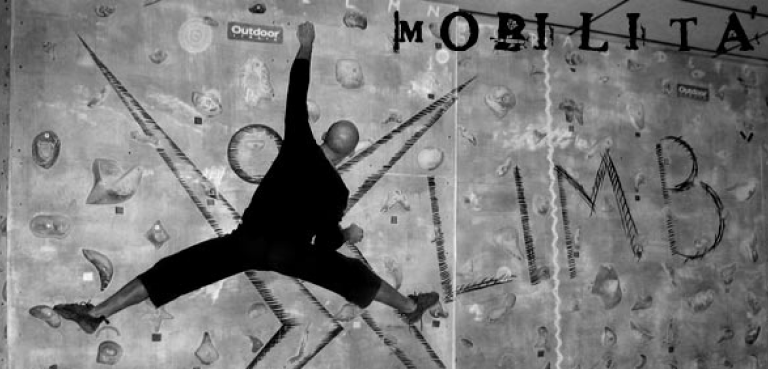
When we talk about mobility we are referring mainly to the elastic properties of the skeletal muscles: tendons are structures with little extensibility, and ligaments, while reasonably elastic, are there to keep the ends of the joints in place. Good mobility means, on the one hand, being able to reach positions that make progress easier and, on the other, being able to move the body with less expenditure of energy. The joint most involved in this respect is the hip, particularly in the movement of raising and externally rotating the thigh with the leg flexed. That movement is restrained in different ways by the glutes, the hamstrings, the adductors and the quadratus lumborum, so a good part of the stretching exercises should be directed at those muscles. Training mobility not only improves performance but helps reduce the chance of injury, and this applies above all to the upper limbs and in particular to the muscles of the shoulder and interphalangeal joints. Doing stretching exercises at the end of a training session helps to clear muscle tightness and aids the physiological recovery of musculature that has accumulated waste.
ADVICE
- The exercises must be done statically, without bouncing
- Every position should be held for at least three minutes
- Do not force it to the maximum: stretching too far triggers a defensive feedback that makes the muscle contract instead of lengthening
- The muscles that are not being stretched should still be relaxed, not contracting in an attempt to hold the position
- To get results the exercises have to be done at least four times a week
- Mobility exercises should be done at the end of the training session
- Before a performance (a competition or a redpoint on rock) mobility exercises can be done beforehand, taking care to stop at least an hour before the competition
PSYCHOLOGY
Training mental abilities only makes sense for high-level athletes, who have to find the best mental state in the moments before a competition. In my own experience as an athlete this was a side I had neglected; as a coach I realised that the mental state can be changed and can, above all, produce substantial improvements in performance. There are specific techniques for this kind of training, but here I do not want to talk about training mental abilities so much as to consider two aspects that, in everyday practice, can affect many people's climbing for the worse: 1) the fear of falling; 2) anxiety about sending. The fear of falling is a natural instinct, justified by the possibility of getting hurt; but if we try to rationalise the matter a little, we have to admit that the chance of getting hurt in a fall is far lower than the one we face driving to the competition or the crag. A well-bolted route, especially a slightly overhanging one, reduces the chance of injury practically to zero. That said, many people stiffen up when they move away from the bolt and change the way they climb; help in getting past this can come from climbing with people who are not afraid of falling and who treat the fall as part of the rules of the game. That does not mean you can always fall safely, but that experience will help you judge whether you are about to dangle in space or to smear yourself over the ledge below. Anxiety about sending shapes the climbing of a great many climbers, from the one who trains every day to the one who never trains. I find it a reaction that gets in the way of any objective analysis of what you are doing: if the outcome of a day's climbing depends solely on whether or not you sent your project, then most of the time was wasted. The surroundings, the rock, the cold air that dries your mouth and glues your hands to the holds, the feeling of tiredness at the end of the day, remain positive experiences even when they are not crowned by the satisfaction of a send. In competition the question is far more complex, amplified by the many hours and the dedication invested, and the anxiety can turn into a fear of winning. Getting past that takes a great deal of will and a coach with the right personality and sensitivity.
INJURIES
We can divide injuries into two kinds: accidental and overuse. The chance of an accidental injury in climbing is low compared with other sports such as football, gymnastics or skiing. In roped climbing it drops almost to zero if the technical equipment is used correctly. In bouldering, on the other hand, repeated falls can damage the intervertebral joints, above all the lumbosacral ones, and the subtalar joint. Accidental injuries happen in every sport and, however many precautions you take, they are often not manageable events. Overuse injuries, by contrast, can be prevented through correct training: the warm-up, stretching and above all the training plan strongly reduce the incidence of this kind of injury. The main problems are located in the hand, the elbow and the shoulder. Hand: the structures under the greatest stress are the proximal interphalangeal joints, the tendons of the superficial finger flexor, the tendons of the deep finger flexor, and the pulleys. The interphalangeal joint becomes inflamed when the fingers work in a half-extended position: in that situation the load "stretches" the joint and the capsule can be damaged, above all if the weight is applied to individual fingers, as with one- and two-finger pockets. The finger flexor tendons become inflamed through repeated overload. The pulleys suffer from the mechanical friction of the angles formed between the ligamentous structures and the tendons themselves. Elbow: the areas that most easily become inflamed are those around the medial and lateral epicondyles of the humerus. The flexors of the hand and fingers and the pronator teres originate from the medial epicondyle, and just below it the bicipital aponeurosis fans out and inserts. This area is the one most subject to myoenthesitis, inflammation affecting the terminal part of a muscle and its tendon. Here, alternating rest with light activity is a sound remedy for the recovery of the damaged structures. Pain at the lateral epicondyle is caused by inflammation of the brachioradialis or of the extensors of the hand and fingers. Another condition at the elbow affects the radial nerve, which because of its path is heavily stressed in the pulling movement; continued compression can damage the structure of the nerve to the point of completely inhibiting pulling. A symptom that precedes serious inflammation of the radial nerve is numbness in the upper limbs at night; stretching and massage can improve the course of the condition. Shoulder: the head of the humerus is held against the glenoid cavity solely by the tension of the joint capsule and the action of the surrounding musculature, which gives the joint excellent range on every plane but exposes it to frequent dislocation. In climbing the glenohumeral joint is subject to considerable stress and the tensions develop in a great many directions, which makes it necessary to strengthen the surrounding musculature evenly so as to produce balanced contractions that keep the joint as stable as possible. It is very important to warm that musculature up by moving the arms in every direction for at least five minutes before starting to train.
ADVICE
- the warm-up has to be specific; you cannot run for 20 minutes and then immediately do maximal work on 1 cm edges. What causes an injury is often poor coordination of the specific musculature rather than poor blood flow. The warm-up has to be completed with specific exercises of increasing intensity
- to train the finger flexors do not use holds smaller than 1.2 cm. It is better to increase the load than to reduce the size of the holds: that allows the load to go up without putting pulleys and tendons in trouble with angles that are too closed. Very small holds should be used only at body weight, to "adapt" the hand to various kinds of grip
- avoid training on single fingers such as one- and two-finger pockets: any improvement is not proportional to the risk of injury
- the electrostimulator is a way of training the muscle without loading the tendons. It can be useful for alternating sessions during a block of strength work, and as a replacement for a session that cannot be done because of joint or tendon inflammation; unfortunately it bypasses the nervous system and the gain in strength is reduced
- drink half a litre of water half an hour before training and then a litre for every hour of training, increasing the amount at temperatures above 25 degrees. Hydration is fundamentally important for tendons, synovial fluid and joints, and guarantees reduced friction between the various structures
- when the trauma is not severe, as in the case of complete or partial ruptures of the structures, complete rest does not aid functional recovery. The best way to recover is to alternate a day of rest with a day of low-intensity training, completely avoiding the exercises that most stress the damaged structures
PROGRAMMING
The basic principle of any training plan is very simple: training too much and training too little lead to exactly the same result, which is not improving. Varying the load in quantity and intensity allows the body to recover energy and to develop every capacity — not only the physical ones but the technical, tactical and psychological ones too. That, however, does not automatically guarantee improvement in the long run. Doing nothing but fingerboard strength exercises for two months, even with well-planned loading and deloading, does not bring a proportional increase in that quality: beyond a certain number of repetitions the training stimulus loses much of its effectiveness. To get the most out of training you have to vary not only quantity and intensity but the type of stimulus as well. For example, if we wanted to devote ourselves to strength training, the first thing to do is list the kinds of exercise available: boulders on slabs, on overhangs, compression problems, finger problems, fingerboard exercises on a straight arm, on a bent arm, one-handed, two-handed, concentric, isometric, eccentric, dynamic exercises on the pan, and so on. Varying the training stimulus lets you recover better from the previous session and, at the same time, keeps you from "getting used" to the stimulus itself. Following a plan brings benefits not only to high-level athletes but to amateur climbers too, and those benefits are not limited to an increase in physical capacity. A good plan reduces injuries, increases awareness of your own way of climbing, and produces more stimulating training precisely because of the variation of stimulus I mentioned. In the end, if we are curious enough to push our climbing to the limit, planning our training is indispensable.
What follows is advice for anyone without the time or the money to be coached by a professional; trying to put together a sheet that plans the various training sessions will certainly do some good.
ADVICE
- if you train up to four times a week (including when you go climbing), do three weeks of loading and one of deload
- if you train more than four times a week (including when you go climbing), do two weeks of loading and one of deload
- every three cycles, add a further deload week
- deload means reducing the quantity of the load by about 60%
- never finish a training session completely exhausted
- vary the type of stimulus as much as possible
- if you have little time, favour specific exercises: to train strength do boulder sessions, for endurance climb onsight